
In modern industrial manufacturing, the widespread adoption of automated equipment, precision robots, and high-frequency drives has significantly improved production efficiency. However, these sensitive devices also place extremely stringent demands on power quality. Even minor power fluctuations, such as voltage sags, harmonic interference, or transient surges, can lead to production line downtime, equipment damage, and substantial economic losses.
Therefore, implementing a real-time power quality monitoring system is no longer an optional extra, but a core cornerstone for ensuring the continuous operation of modern manufacturing plants.
Power quality refers to the ability of the power supply system and the electrical equipment to operate in harmony. Ideally, electrical power should be a perfect, continuous sinusoidal waveform. However, in real-world manufacturing environments, common power quality problems include:
Voltage Sags & Swells: Brief drops or rises in voltage, usually caused by the starting of high-power motors or grid faults, can easily lead to VFD tripping.
Harmonic Distortion: Caused by nonlinear loads (such as rectifiers, LED lighting, and computers), it leads to excessive heating of inverters, transformers, and motors, accelerating equipment aging.
Transient Surges: Extremely short-duration high-voltage pulses caused by lightning strikes or switching operations can directly burn out sensitive electronic components.
Voltage Unbalance: Asymmetry in the amplitude or phase of three-phase voltages leads to decreased motor efficiency, increased vibration, and shortened lifespan.
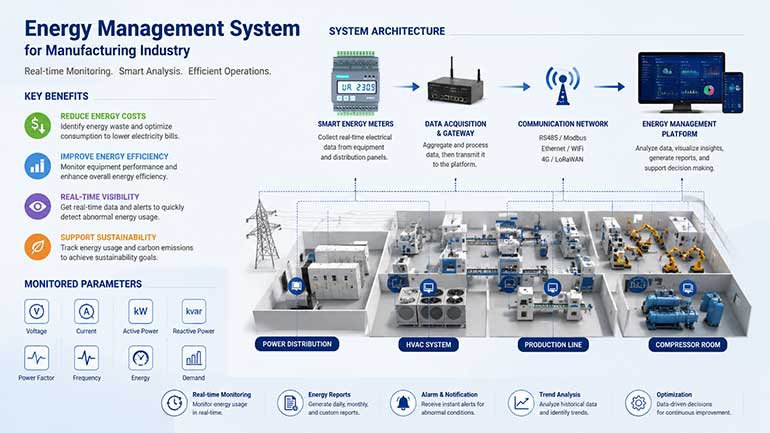
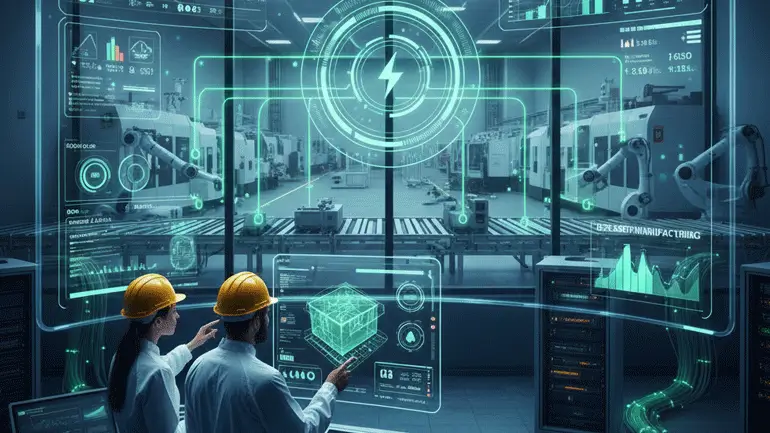
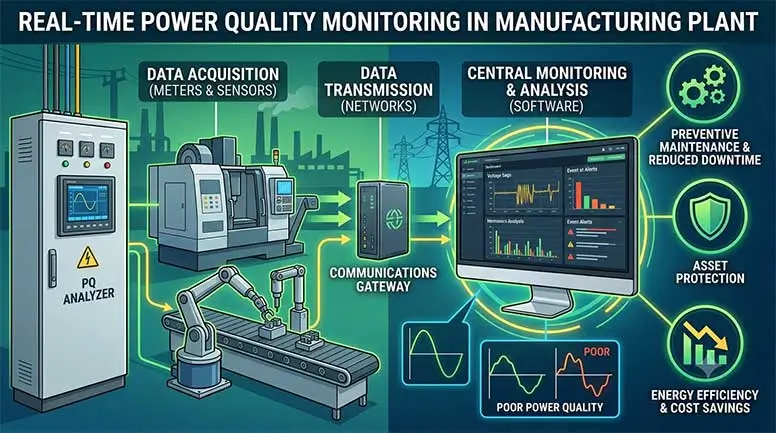
An efficient real-time power quality monitoring system typically consists of the following three layers:
Data Acquisition Layer (Instruments and Sensors): Advanced power quality analyzers are installed in front of the main incoming line cabinet, critical branch circuits, and core equipment (such as CNC machine tools and robot workstations). These instruments have high sampling rates and can capture transient events at the microsecond level.
Data Transmission Layer (Gateway and Network): Data is uploaded to the central system in real time via protocols such as Modbus RTU or MQTT, ensuring data synchronization and integrity.
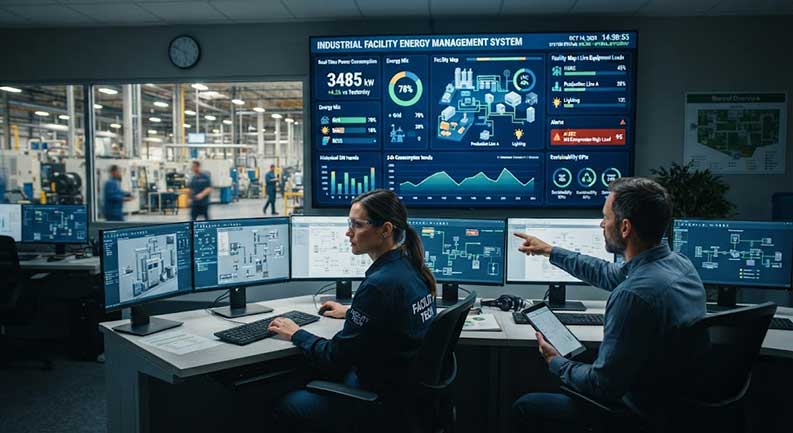
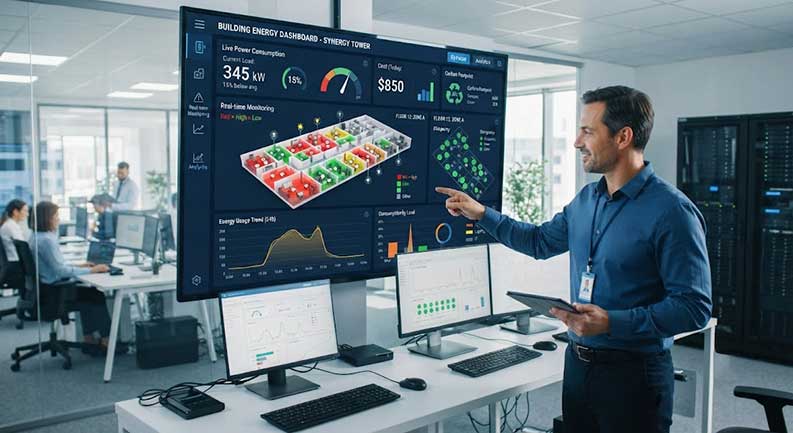
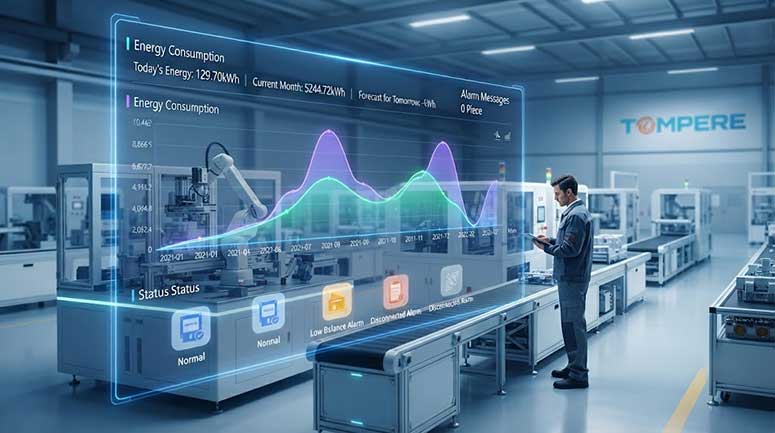
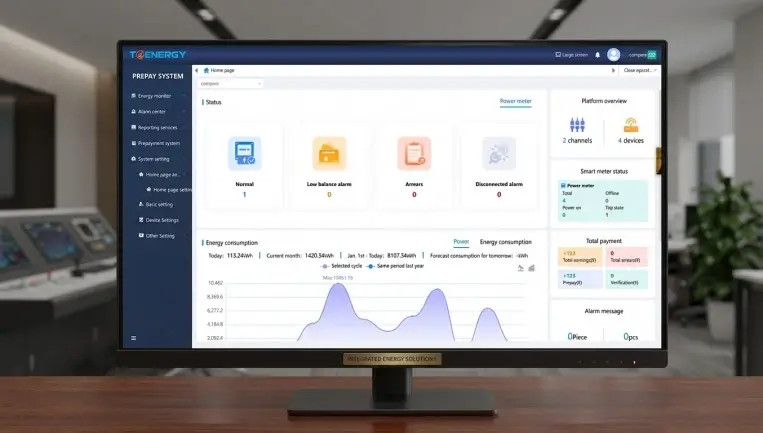
Data Application Layer (Software and Analysis): Monitoring software visualizes massive amounts of data, providing real-time dashboards, trend charts, waveform analysis, and fault alarms.
1. Preventative Maintenance and Reduced Unplanned Downtime
By monitoring voltage and current waveforms in real time, the system can identify abnormal signs before equipment fails completely. For example, an abnormal increase in harmonic content may indicate an impending failure of a capacitor bank. Engineers can schedule maintenance in advance without affecting production, avoiding catastrophic downtime.
2. Accurate Root Cause Analysis (RCA)
When a production line unexpectedly shuts down, factories often get bogged down in debating whether it's a power grid problem or a faulty equipment. Real-time monitoring systems, with their Sequence of Events (SOE) and waveform capture capabilities, can accurately record voltage and current trajectories before and after a fault, helping technicians pinpoint the source of the fault within minutes.
3. Protecting High-Value Assets
Sensitive manufacturing equipment (such as semiconductor lithography machines and precision injection molding machines) is expensive. Real-time monitoring systems can trigger protection mechanisms or issue alarms within milliseconds upon detecting severe voltage drops or surges, minimizing the risk of equipment damage.
4. Optimizing Energy Efficiency and Reducing Costs
Poor power quality is often accompanied by high reactive power and low power factor, which can lead to fines from power companies. Through monitoring, factories can accurately design and implement var compensators (SVG) or active power filters (APF) to improve the power factor, eliminate grid fines, and reduce internal line losses.
Comprehensive Coverage vs. Critical Protection: Due to cost considerations, factories do not need to install the highest-specification instruments at every node. It is recommended to use a Class A accuracy power quality analyzer at the main incoming line to define the power company's responsibility; while deploying economical monitoring points before critical core equipment.
Software Intelligence (AI & Big Data): The future of power quality monitoring is moving towards incorporating artificial intelligence. AI algorithms can automatically identify waveform characteristics, classify faults, and even predict the remaining lifespan of equipment.
Integration with MES/ERP systems: By connecting power quality data with Manufacturing Execution Systems (MES), it's possible to analyze "which type of product experiences the greatest power fluctuations" or "which type of power interference has the highest impact on product yield," thereby optimizing production strategies at a higher level.
In the pursuit of "Industry 4.0" and smart manufacturing, a stable power supply is like the "blood" of a factory. Real-time power quality monitoring systems are not only diagnostic tools but also strategic investments to ensure the safety of manufacturing assets, improve operational efficiency, and achieve energy conservation and emission reduction. By making invisible power quality problems "visible," modern factories can firmly grasp the initiative in production continuity.
Have you any problem, please contact us via message