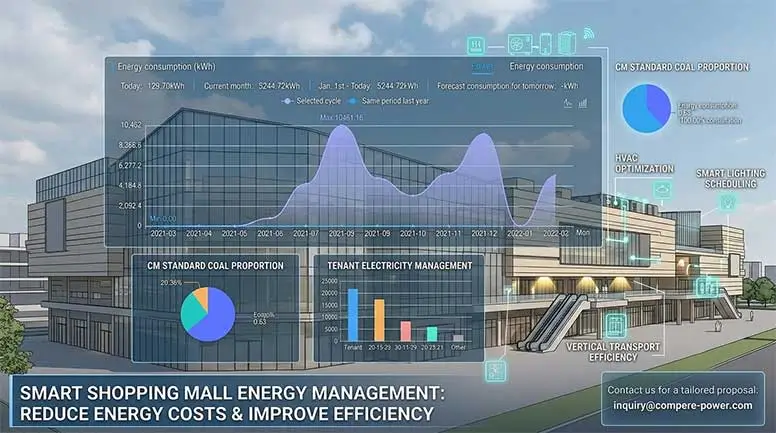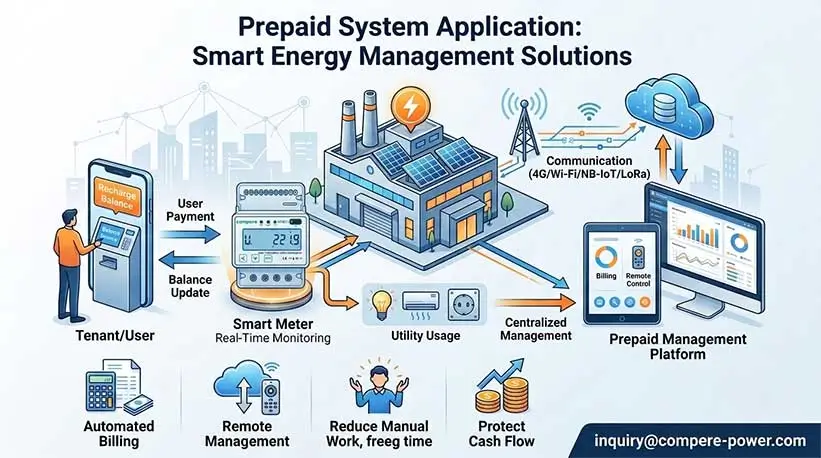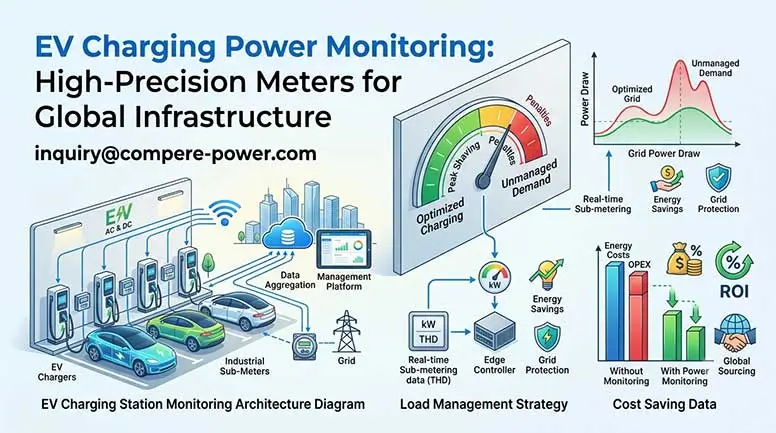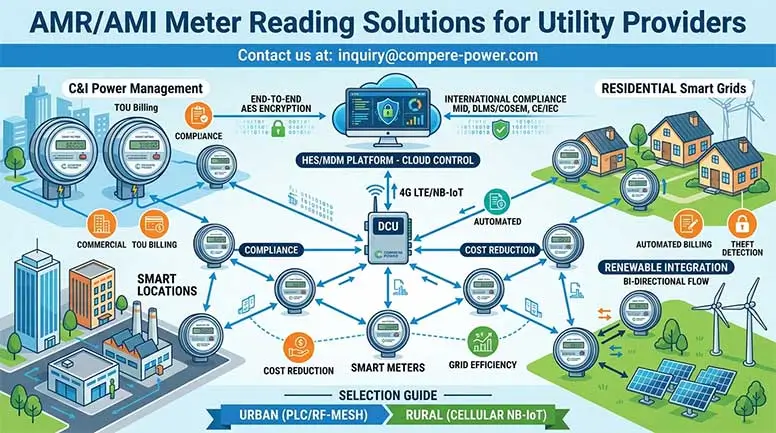

Office building power monitoring refers to the continuous, localized deployment of dedicated electronic instruments and software engines engineered to acquire, transmit, and evaluate real-time power metrics across sub-circuits within commercial multi-tenant environments. Unlike primary sub-station boundary utility billing meters, localized sub-metering configurations isolate specific internal physical distributions to evaluate energy trends by floor, functional branch, or individual high-consumption machine groups.
A resilient system framework focuses systematically on several architectural levels:
Operating a facility without advanced sub-metering capabilities poses operational and financial challenges to facility management teams, energy services companies, and property groups.
Large commercial installations exhibit extensive base loads driven by central heating, ventilation, and air conditioning (HVAC) configurations, heavy building illumination, server spaces, and extensive employee workstation machinery. Without discrete sub-circuit metering, identifying uncalibrated machinery groups or active systems during non-working weekend phases remains difficult, causing high peak-demand utility surcharges.
Bulk utility bills fail to illustrate transient surges or identify which specific tenant zone or infrastructure group is running inefficiently. This severe structural blind spot prevents building engineers from making data-backed maintenance choices or implementing objective department-level utility accountability programs.
Modern premium office high-rises integrate complex, multi-tiered power networks spanning several switchgear levels, emergency power sets, and sub-distribution nodes. Manual verification is inefficient and highly prone to error. Deploying a comprehensive commercial building power monitoring solution resolves this operational complexity by funneling individual terminal telemetry pipelines directly into an analytical control center.
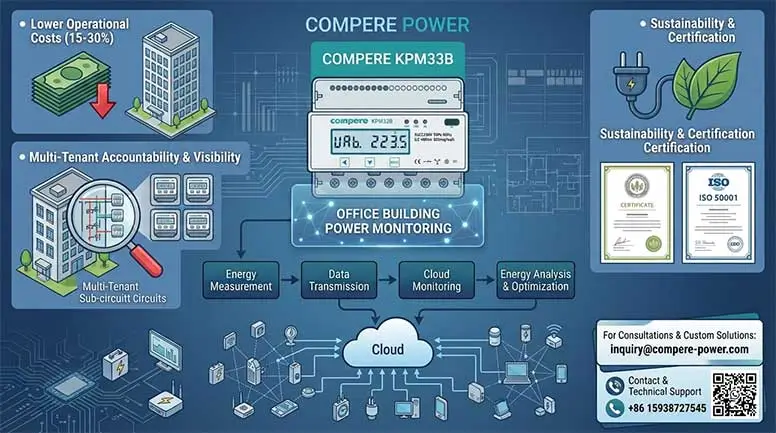
A professional commercial energy solution functions as an integrated technology stack divided into three clear operational stages, moving securely from electrical physical inputs up to localized user-facing analytics.
Industrial-grade, highly precise instrument configurations—including a dedicated smart energy meter for buildings and matched split-core current transformers—are integrated into primary distribution distribution networks, mechanical plant centers, and floor-level distribution panels. These devices constantly analyze localized loading conditions without disrupting existing supply paths.
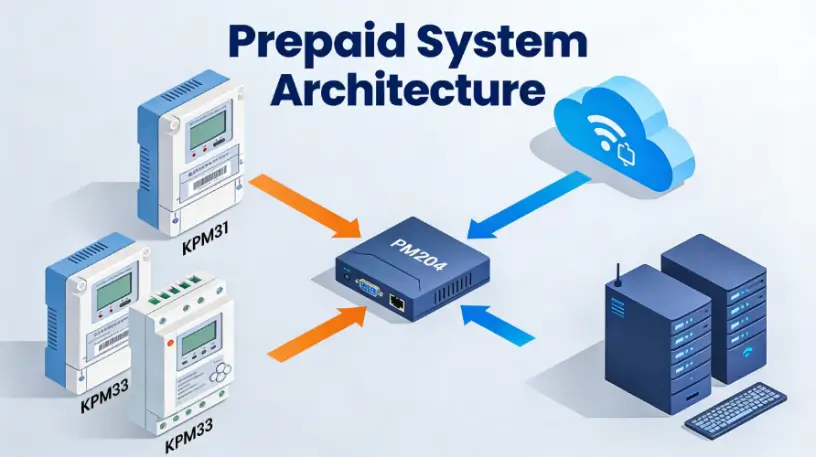
The raw parametric telemetry collected at the point of measurement must be securely sent across the facility infrastructure. To maintain robust long-distance transmission, systems use open-standard industrial protocols. Wired loops utilize field-proven serial configurations, while distributed retrofits rely on long-range wireless networks such as cellular connections or wireless local networks to link field nodes to the central gateway.
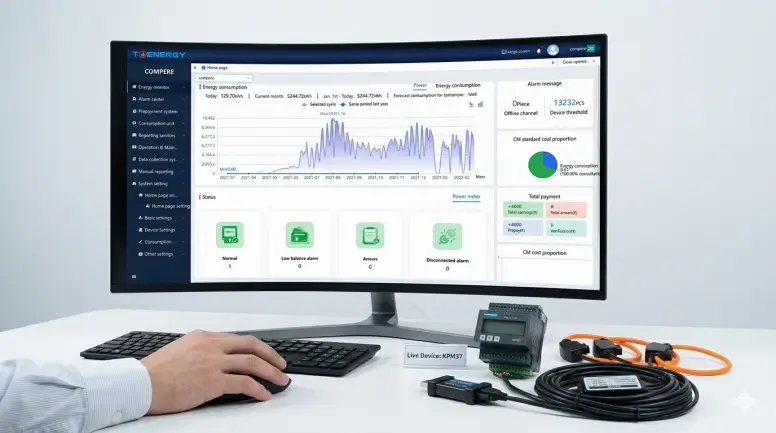
The system uploads incoming data frames directly to an interactive, cloud-based commercial energy management system platform. The software converts this structured data stream into accessible visual elements, generates tracking trends, logs structural power factor deviations, and alerts facility managers when custom usage thresholds are crossed.
To successfully optimize large commercial installations, a robust building electricity monitoring system must include these core features:
| System Feature & Capability | Direct Practical Benefit for Building Operators |
|---|---|
| Floor-Level & Area Sub-Metering | Isolates and records precise energy signatures by floor or corporate tenant zone. Helps eliminate billing disputes and supports precise consumption accountability. |
| Real-Time Demand Tracking | Constantly checks maximum load levels to support active load-shedding strategies, helping facilities avoid costly peak-demand utility surcharges. |
| Automated Analytical Reporting | Generates regular, structured energy consumption summaries that allow property groups to track efficiency trends and verify energy savings. |
| Power Quality Metric Logging | Monitors transient voltage variations and phase balancing to safeguard sensitive server hardware and heavy building equipment from premature wear. |
| Centralized Cloud IoT Architecture | Consolidates multi-site building data into a unified platform, significantly reducing manual inspection hours and streamlining team operations. |
Provides asset management firms the baseline metrics needed to evaluate overall infrastructure efficiency, identify off-hour power waste, and design targeted operational improvements that protect bottom-line margins.
Acts as an essential technical input layer for modern building networks, feeding clean power usage profiles into automation systems to coordinate smart climate and adaptive lighting routines based on real-time occupancy loads.
Replaces old, inaccurate square-footage calculations with transparent, accurate sub-billing metrics. Tenants only pay for the exact energy volumes they draw, which naturally encourages sustainable corporate behavior.
Protects distributed business campus layouts and centralized corporate properties from sudden power disruptions by identifying systemic harmonic distortion and balancing multi-phase distribution panels before component failures occur.
Integrating a scalable remote power monitoring system provides property stakeholders clear operational and financial advantages:
An industrial-grade solution should be evaluated across several core criteria to match the technical needs of the facility:
Verify that field devices track true RMS values beyond basic kilowatt-hour totals. Professional architectures require multi-tariff capability, peak demand recording, voltage dip/swell alarms, and full phase parameter tracking.
The chosen architecture must integrate easily with your current asset frameworks. Ensure the smart sub-meters support open industrial standard open protocols to prevent restrictive vendor lock-in and simplify future expansions.
Commercial assets undergo regular structural modifications and tenant expansions. Select a flexible, modular platform that allows you to start with a few critical panels and scale up to a comprehensive multi-site property grid over time.
Partner with an established manufacturer that has demonstrated production experience, comprehensive engineering validation records, long equipment lifespans, and specialized engineering support teams.
As an established, professional smart energy meter manufacturer, we deliver complete, field-tested IoT energy monitoring solution arrays designed for demanding commercial real estate environments. Our solutions bring together highly accurate measurement devices and scalable software systems into a single, cohesive framework.
Our instruments provide premium measurement accuracy, compact physical sizing for clean electrical enclosure integration, and versatile open-protocol data transmission choices. Whether your project requires standard wired layouts or distributed, wireless setups for older building upgrades, our hardware options integrate smoothly with your existing IT networks. Backed by extensive global project experience, we support engineering contractors, integration specialists, and commercial facility teams with reliable hardware manufacturing capabilities and comprehensive OEM/ODM customization services tailored to specific project requirements.
Q1: What is Office Building Power Monitoring?
A1: It is an integrated framework of high-accuracy smart sub-meters, industrial communication gateways, and software analytical suites that track, transmit, and analyze real-time electrical parameters across a commercial property's distribution infrastructure.
Q2: How does power monitoring help reduce office building energy costs?
A2: The system uncovers hidden energy waste—such as mechanical equipment running needlessly during unoccupied hours—and tracks peak loading intervals. This allows facilities teams to optimize operational schedules and avoid peak demand utility penalties.
Q3: What equipment is required for building power monitoring?
A3: A typical commercial layout includes precision smart sub-meters and matching current transformers installed inside electrical distribution panels, industrial communication gateways to manage protocol conversion, and a centralized energy monitoring platform to process data.
Q4: Can office building power monitoring systems support remote management?
A4: Yes. By connecting smart energy sub-meters to secure industrial gateways, the acquired electrical telemetry is uploaded to unified cloud applications, giving facility managers and property owners full dashboard visibility from any terminal.
Optimize your commercial property infrastructure, lower operational expenditures, and achieve complete energy transparency with an enterprise-grade office building energy monitoring system tailored to your site specifications. Contact our senior application engineering team today to receive detailed technical specifications, request a competitive product quotation, or arrange a direct, one-on-one technical consultation for your project.
Email your project requirements directly to our engineering desk: [email protected]
Have you any problem, please contact us via message