
The global electric vehicle (EV) infrastructure is undergoing an unprecedented shift toward high-power density and grid-interactive distribution. For EV charging station manufacturers, charge point operators (CPOs), and Engineering, Procurement, and Construction (EPC) contractors, scaling a network involves hurdles far beyond basic power delivery. Operating a modern commercial charging site requires multi-vector optimization across strict regulatory grid codes, severe thermal profiles, and volatile operational expenditure (OPEX).
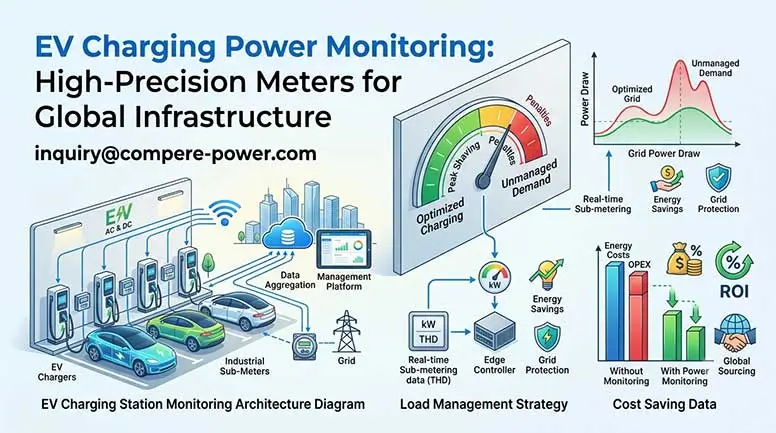
At the center of this structural reliability is the energy measurement and telemetry sub-system. Implementing a ruggedized EV Charging Station Power Monitoring architecture is the definitive baseline for ensuring continuous uptime, preventing localized grid overloads, and unlocking automated fiscal billing. This technical brief details the integration methodologies that solve the structural bottlenecks of compliance, cost, and efficiency for global utility-scale deployments.
International market entry and asset operations present technical and financial risks that can halt high-capital infrastructure projects. Our smart power monitoring solutions neutralize these risks at the component and system level.
Deploying charging infrastructure across different legal regions requires strict adherence to local metrology frameworks. In North America, the National Type Evaluation Program (NTEP) and UL 61010 standards enforce strict safety and structural safeguards. Our sub-metering hardware eliminates technical integration risks by matching these international legal frameworks natively, preventing field re-engineering, structural compliance audits, or retrofitting penalties.
High-capacity fast-charging installations put significant stress on local distribution transformers. Unmanaged peak loads expose operators to severe demand penalties from utility providers, while internal phase imbalances cause premature component degradation. Integrated power monitoring enables millisecond-level telemetry tracking of active power (kW), reactive power (kVAR), and Total Harmonic Distortion (THD). This granular data feed allows local edge controllers to run dynamic load balancing (DLB) algorithms. By shedding or shifting loads across chargers, operators can shave peak consumption, avoid infrastructure upgrades, and protect capital expenditure (CAPEX).
Manual field maintenance is a logistical bottleneck that degrades network profitability. Our power monitoring hardware acts as a diagnostic sensor array, transmitting structural health metrics alongside standard energy consumption data. By tracking continuous current profiles and voltage drop deviations, the system identifies anomalies such as contactor degradation or connector wear before a critical fault occurs. This telemetry enables predictive maintenance workflows, decreases Mean Time to Repair (MTTR), and guarantees the high operational uptime required to meet commercial Service Level Agreements (SLAs).
Sourcing engineers and international B2B buyers evaluate components based on rigorous validation criteria. Our architecture satisfies these procurement demands through three foundational pillars:
The following engineering data table lists the precise operational constraints and measurement parameters across our specialized AC and DC power monitoring product lines:
| Engineering Attribute | DC Fast & Ultra-Fast Charging (Level 3) | AC Commercial & Fleet Charging (Level 2) |
|---|---|---|
| Product Series Assignment | Compere EV-DC800 Base | Compere EV-AC300 Base |
| Metrological Accuracy Class | Class 0.5S (Active Energy, IEC 62053-22) | Class 1.0 (Standard) / Class 0.5S (Optional) |
| Voltage Measurement Envelope | 150V DC to 1000V DC (Extended Range) | 230V / 400V AC Nominal (Three-Phase Delta/Wye) |
| Current Sensor Configuration | External Cryogenic Shunt (75mV) / Hall-Effect | Direct Insertion up to 80A / External CT (5A/100mA) |
| Native Communication Protocols | Modbus-RTU, MQTT over Ethernet, DLMS | Modbus-RTU (RS485), Modbus-TCP, Native OCPP Link |
| Internal Signal Sampling Rate | 8.0 kHz Simultaneous Sampling | 4.8 kHz Continuous Sampling |
| Legal Metrology & Safety Marks | CE, UL Listed, RoHS Compliance | CE, UKCA Compliance |
| Mechanical Form Factor | 35mm DIN-Rail Mount (Standard Enclosure) | 35mm DIN-Rail Mount (2-Module / 4-Module Width) |
| Operational Thermal Envelopes | -40°C to +85°C (Non-Condensing Atmosphere) | -30°C to +70°C Ambient Atmosphere |
In high-power charging architectures (150kW to 480kW+ Liquid-Cooled Systems), rapid thermal fluctuations alter the internal resistance of busbars and current paths. The EV-DC800 tracking engine uses real-time temperature-compensated calibration curves to ensure stable billing accuracy across the entire voltage range, preventing revenue loss during high-current charging cycles.
Managing multi-vehicle logistics facilities requires strict coordination between charging schedules and facility consumption. Our AC and DC sub-meters feed continuous load data directly into energy management systems (EMS). This allows the facility to prioritize fleet vehicles based on departures, distribute power evenly across phases, and run automated expense allocation through built-in software APIs.
Next-generation charging hubs are shifting from simple consumers to bi-directional nodes within local microgrids. Our meters support true four-quadrant energy measurement, tracking imported and exported active and reactive energy. This structural telemetry feed is critical for orchestrating charging cycles alongside solar PV arrays, battery energy storage systems (BESS), and localized grid ancillary services.
When selecting a sub-metering component for an industrial charging system, procurement teams should evaluate the following hardware factors to avoid integration bottlenecks:
A: Our meters feature structural multi-layer electromagnetic shielding designs and isolated circuit components that decouple the metrology core from high-frequency electromagnetic interference (EMI). The digital signal processing pathways filter out commutation noise generated by silicon carbide (SiC) or IGBT inverters, ensuring consistent Class 0.5S tracking performance.
A: Industrial sub-meters communicate using raw, low-latency field buses like Modbus-RTU or Modbus-TCP to maximize hardware reliability. These data registers are polled by the charging station's main controller or local gateway, which encapsulates the electrical metrics into standard structural formats such as the MeterValues payload within OCPP 1.6J or OCPP 2.0.1 for secure transmission to central cloud platforms.
A: DC fast charging piles generate substantial thermal energy during continuous high-current delivery. Standard commercial meters degrade or drift in accuracy when operating inside tightly sealed cabinets that frequently exceed 60°C. Our industrial-grade metrology units are rated up to +85°C, implementing specialized silicon components to maintain calibration stability under extreme thermal stress.
Don't let regulatory friction or component-level data errors slow down your global infrastructure deployment. Secure your supply chain with validated, certified, and hardened power monitoring components engineered for high-uptime operations.
Ready to elevate your system performance? Send your detailed project specifications and compliance requirements to our global support desk at [email protected]. Get a tailored, hardware-validated site blueprint and an introductory evaluation sample package delivered directly to your engineering laboratory.
Have you any problem, please contact us via message