
Energy management has become a critical challenge for industrial companies, commercial buildings, and infrastructure operators. With increasing electricity costs and growing requirements for efficient energy use, businesses need more than traditional monthly electricity bills or manual meter readings to understand their power consumption.
Many companies still rely on basic energy monitoring methods, which only provide limited information after energy consumption has already occurred. This makes it difficult to identify abnormal energy usage, inefficient equipment operation, or unnecessary power waste in real time.
A real time energy monitoring system provides an effective solution by allowing businesses to continuously collect, analyze, and manage electricity data through smart meters, communication networks, and energy management platforms.
By transforming energy consumption into visible and actionable data, companies can improve operational efficiency, reduce energy costs, and make better decisions based on actual energy usage patterns.
A real time energy monitoring system is an integrated solution that enables continuous measurement and analysis of electrical energy consumption. Unlike traditional monitoring methods that only provide periodic readings, real-time monitoring allows users to view power data instantly and remotely.
A complete real time energy monitoring solution usually consists of three main components:
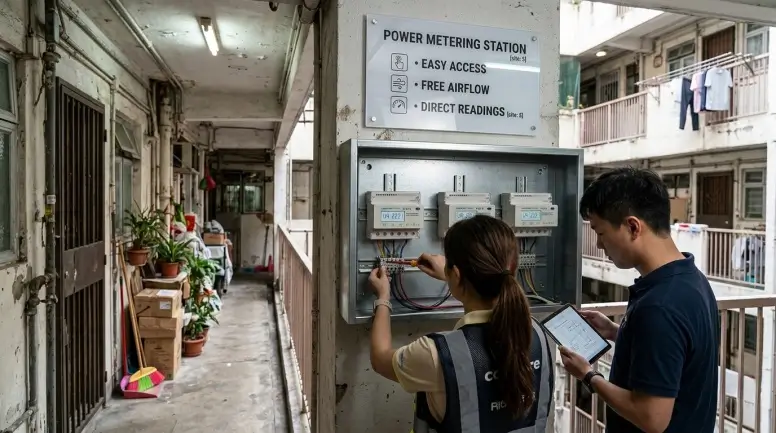
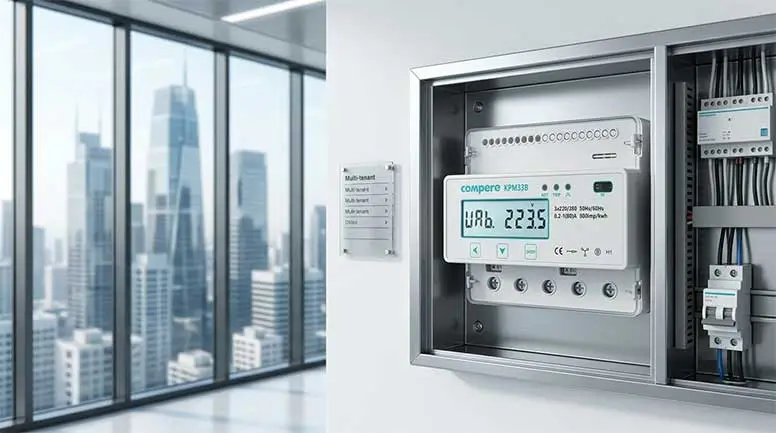
Smart energy meters are the primary data collection devices within the system. They measure important electrical parameters, including:
Installed at key locations such as production lines, distribution panels, or individual electrical circuits, smart meters provide detailed information about where and how electricity is being consumed.
For industrial applications, advanced smart meters can monitor multiple energy points simultaneously, helping facility managers understand energy usage across different departments, machines, and buildings.
The communication gateway works as a bridge between field devices and the energy management platform.
After collecting data from smart meters, the gateway transfers information through different communication technologies, such as:
For large industrial facilities or multi-building projects, wireless communication solutions can reduce installation complexity and provide flexible deployment options.
The energy management platform is where collected data is displayed, analyzed, and converted into useful insights.
Users can access:
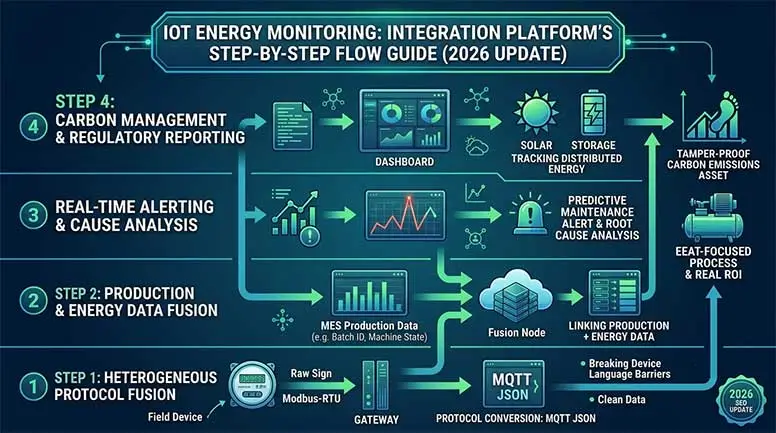
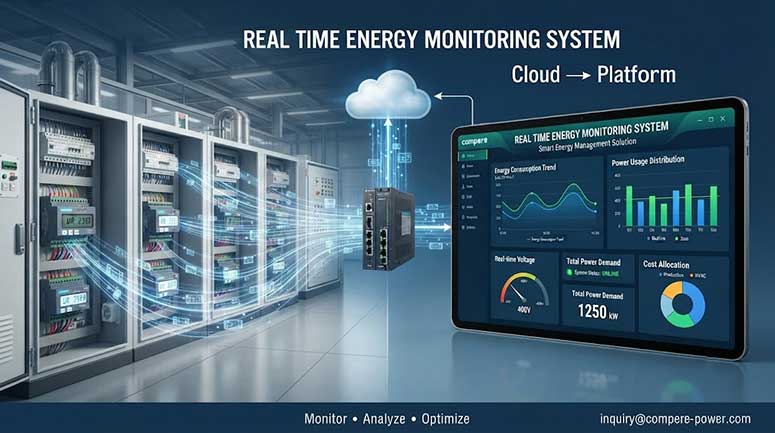
The complete data flow can be summarized as:
Smart Energy Meter → Communication Gateway → Cloud Platform → Energy Analysis & Management
One of the biggest challenges for businesses is the lack of detailed energy information.
Traditional electricity bills only show total consumption over a certain period. They cannot explain:
A real time energy monitoring system provides continuous visibility into electricity consumption.
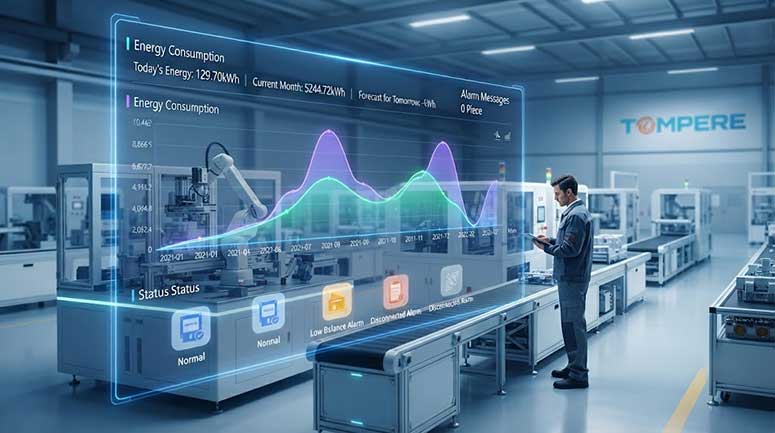
For example, a factory can monitor energy usage from different production lines and compare consumption between machines. This helps managers identify inefficient processes and optimize energy allocation.
Energy waste often happens silently. Common examples include:
Without real-time monitoring, these issues may remain unnoticed for weeks or months.
With a smart energy monitoring system, abnormal consumption patterns can be detected quickly through data analysis and alarm notifications.
Energy management requires accurate information. A real time energy monitoring solution provides valuable data that helps businesses:
A real time energy monitoring system continuously collects electrical data from smart meters and transfers it to a centralized energy management platform for analysis and decision-making.
Smart energy meters are installed at important monitoring points, such as:
These meters continuously measure voltage, current, power, frequency, power factor, and energy consumption.
After collecting electrical data, smart meters transmit information to the monitoring platform through wired or wireless communication technologies.
Common communication methods include:
The platform processes collected data and displays information through dashboards and reports.
Users can monitor:
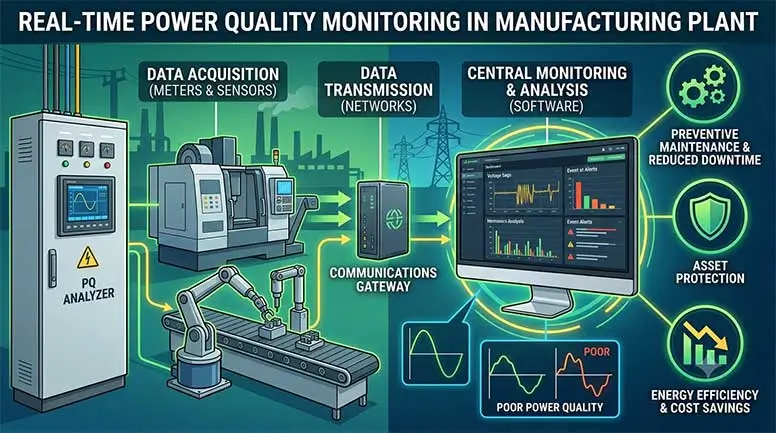
Manufacturing facilities are among the most common users of real-time energy monitoring solutions.
Factories can use smart energy meters to monitor:
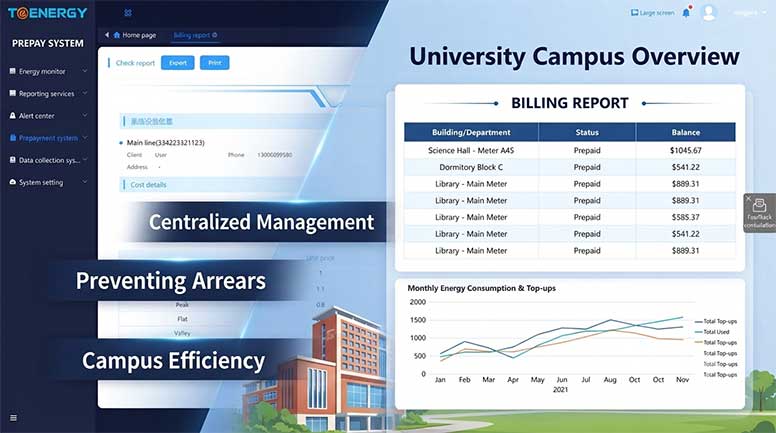
Commercial buildings such as offices, shopping centers, hotels, and campuses require efficient energy management for lighting systems, HVAC systems, elevators, and other electrical equipment.
A smart energy monitoring system helps building operators understand consumption patterns and optimize energy usage.
Data centers require highly accurate power monitoring because small efficiency improvements can create significant cost savings.
Real time energy monitoring systems help track:
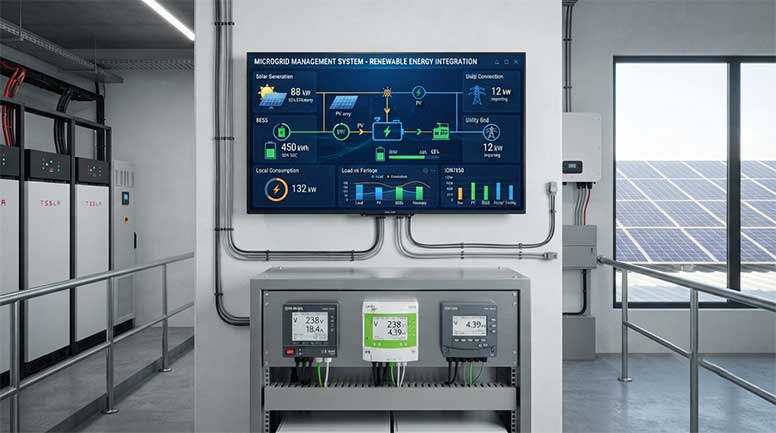
Real-time monitoring solutions can integrate data from solar power systems, energy storage systems, grid connections, and local loads to improve energy utilization.
| Feature | Business Value |
|---|---|
| Real-time energy visibility | Understand electricity consumption instantly |
| Remote monitoring | Reduce manual inspection requirements |
| Historical data analysis | Identify long-term energy trends |
| Alarm notifications | Quickly detect abnormal consumption |
| Multi-device integration | Manage multiple energy points in one platform |
| Data-based decisions | Improve energy efficiency strategies |
Accurate data is the foundation of effective energy management. The selected smart energy meters should provide reliable measurement of voltage, current, active energy, reactive energy, power factor, and demand values.
A flexible system should support common communication protocols, including:
A suitable system should support multiple smart meters, multiple buildings, different monitoring locations, and future IoT expansion.
A real time energy monitoring system is a solution that uses smart meters, communication technologies, and software platforms to continuously collect and analyze electricity consumption data. It enables businesses to monitor energy usage instantly and improve energy management efficiency.
A real time energy monitoring system helps reduce energy costs by identifying unnecessary consumption, abnormal energy usage, and inefficient equipment operation. Businesses can optimize operation schedules and implement targeted energy-saving strategies based on accurate data.
Yes. Many energy monitoring systems support integration with existing smart meters through communication protocols such as RS485 and Modbus, allowing companies to upgrade their energy management capabilities without replacing all existing devices.
Real time energy monitoring systems are widely used in industrial manufacturing, commercial buildings, data centers, renewable energy projects, and microgrid applications where accurate energy monitoring is required.
Energy management is becoming increasingly data-driven. Traditional methods based only on periodic meter readings cannot provide the detailed information businesses need to optimize energy consumption.
A real time energy monitoring system combines smart energy meters, communication technology, and energy management software to provide continuous visibility into electricity usage.
For industrial companies, commercial buildings, and energy solution providers, real-time monitoring creates opportunities to reduce energy waste, improve operational efficiency, and make better decisions based on accurate data.
As energy costs continue to increase and digital transformation accelerates, implementing a reliable real time energy monitoring solution is becoming an important step toward smarter and more sustainable energy management.
Have you any problem, please contact us via message