
In today's pursuit of ESG (Environmental, Social, and Governance) metrics and digital transformation, many industrial manufacturing facilities and smart parks face a significant technological gap: their infrastructure still relies on outdated electricity meters that have been in service for 5-10 years. These traditional devices mostly only support the Modbus-RTU protocol within a local area network and cannot directly interface seamlessly with modern cloud-based energy management systems (EMS) or IoT platforms (such as Alibaba Cloud, AWS IoT, and Azure).
This is the most typical "last mile" pain point in Industrial IoT (IIoT). This article will provide a lightweight integration solution for seamlessly connecting traditional Modbus electricity meters to the MQTT cloud platform via a gateway, starting with technical architecture, gateway configuration, pain point analysis, and real-world case studies.
At the outset of a project, the OT (Operations Technology) and IT (Information Technology) teams often grapple with the following three pain points:
High Replacement Costs and Power Outage Risks: Replacing hundreds or thousands of traditional meters in a factory with new IoT meters is not only prohibitively expensive in terms of hardware procurement, but more importantly, it requires partial power outages and work stoppages, which is almost unacceptable for industrial production lines operating 24/7.
The Challenge of Transmitting Unstructured Data: Modbus-RTU, as a traditional serial link protocol, transmits hexadecimal data from underlying registers. Directly transmitting this raw data remotely would not only severely deplete the computing power of cloud-based parsing servers but also fail to meet the structured communication requirements of modern cloud platforms based on JSON format.
Data Packet Loss and Blind Spots: Industrial sites suffer from severe electromagnetic interference and unstable networks. If the gateway uses simple "transparent transmission," a brief interruption of the cloud connection will result in the complete loss of energy consumption data for that period, leading to blind spots in financial reconciliation or carbon emission accounting.
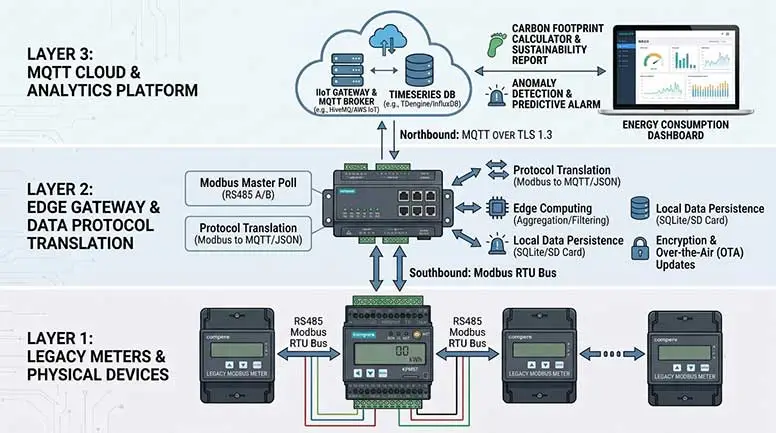
To address the aforementioned pain points without altering existing hardware systems, industrial IoT solutions generally adopt a three-layer decoupled architecture: "Physical Layer - Edge Gateway Layer - Cloud Platform Layer." This perfectly transforms the underlying Modbus polling into a cloud-based MQTT publish/subscribe model.
1. Physical Device Layer (Lower-Level Data Acquisition)
Traditional electricity meters are connected in a daisy-chain configuration via RS485 bus, with a maximum transmission distance of up to 1200 meters. The gateway, acting as the Modbus Master, periodically polls the registers of each meter Slave according to a set schedule to obtain underlying raw data such as voltage, current, active power, and cumulative electricity consumption.
2. Edge Gateway Layer (Southbound to Northbound Protocol Conversion)
The smart gateway is the soul of the entire architecture, responsible for the smooth conversion from Modbus to MQTT:
Northbound MQTT Conversion: The gateway decodes the collected Modbus binary data and packages it into structured JSON messages according to the IoT platform's object model standard. This data is then published to the specified topic via the MQTT protocol.
Disconnection Resumption Mechanism: When the plant network goes offline or the MQTT connection is lost, the gateway temporarily stores energy consumption data using local storage (such as built-in flash memory or an SQLite database). After the network is restored, the gateway resends the data via MQTT messages with historical timestamps, ensuring the integrity of cloud data.
3. Cloud Platform Layer (Application and Presentation)
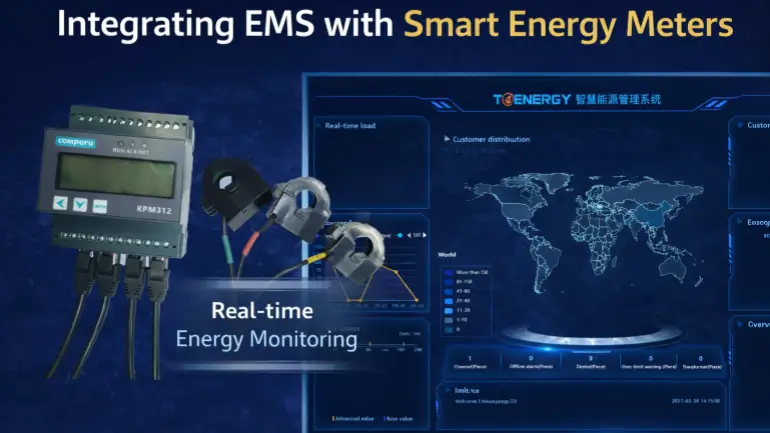
After receiving the messages, the cloud MQTT Broker distributes the data to the energy management dashboard and time-series database (InfluxDB / TDengine). Enterprises can monitor energy consumption in real time through standard APIs or web interfaces, enabling carbon footprint tracking and abnormal electricity usage alerts.
To achieve smooth integration, engineers need to complete the following four key implementation steps:
1. Physical Network Cabling and Interference Prevention: RS485 links must use twisted-pair shielded cable, and a 120-ohm terminating resistor must be connected at the end of the bus to suppress Modbus message distortion caused by industrial electromagnetic noise.
2. Define Data Point Tables and Data Conversion: Configure the Modbus register address in the gateway backend. For example, if the "A-phase voltage" of a certain brand of electricity meter is known to be stored in holding register 0x0002, with a data type of 32-bit floating-point, the gateway needs to be correctly configured with big-endian/little-endian mode. Simultaneously, define the corresponding MQTT JSON field name in the gateway.
3. MQTT Triggered Reporting (Report by Exception): To save cloud bandwidth and storage costs, avoid frequently reporting unchanged instantaneous voltage. It is recommended to set triggered reporting (e.g., report once for every 1kWh increase in accumulated power, or once for voltage fluctuations exceeding 5%), while regular data should be aggregated and reported every 5-15 minutes.
4. Security Hardening: TLS 1.3 encrypted transmission must be enabled between the gateway and the cloud MQTT server, and a one-device-one-key authentication method must be used. Unencrypted, bare-metal MQTT connections to the public network are strictly prohibited.
Q1: What is the latency performance after converting Modbus-RTU to MQTT? Will it affect real-time control?
A: Protocol parsing of industrial IoT gateways is typically completed within tens of milliseconds. Uploading to the cloud via MQTT generally has a latency of around 100ms-500ms. It's important to clarify that this architecture is primarily used for energy consumption monitoring, trend analysis, and auditing, and is a non-real-time/near real-time system. If your scenario requires millisecond-level closed-loop real-time control (such as anti-islanding circuit breaker tripping), please ensure the control logic is implemented at the local PLC level, and do not rely on the cloud MQTT link.
Q2: How to avoid MQTT data confusion when multiple Modbus meters are connected daisy-chain?
A: On the Modbus physical link, each meter must be configured with a unique slave ID (Slave ID / Unit ID). During gateway configuration, you need to assign a corresponding tag to each Slave ID. When the gateway converts to MQTT reporting, you can add the meter identifier to the JSON message, or use the MQTT topic hierarchy for differentiation.
Q3: What are the requirements for local storage for the gateway's "resumable connection after disconnection" function?
A: Most mainstream industrial gateways currently have built-in eMMC storage or industrial-grade MicroSD cards. When selecting a gateway, ensure it supports cyclic overwrite logging and wear leveling technology. For example, with 200 meters reporting data every 5 minutes, 1GB of local storage is sufficient to store over 6 months of data, eliminating concerns about memory card damage due to frequent read/write operations.
Have you any problem, please contact us via message