
In remote areas, isolated industrial zones, or critical infrastructure with extremely high requirements for power continuity, off-grid microgrids are rapidly becoming a core solution for ensuring energy independence. However, to perfectly coordinate the dynamic balance between solar power, battery energy storage (BESS), and backup grid/generator power in an environment completely disconnected from or independent of the main grid, a high-precision microgrid power monitoring system is indispensable.
A typical off-grid/multi-energy complementary microgrid system mainly consists of the following three core components, each playing a different role:
Solar PV System: The intermittent "producer." Power generation depends entirely on the weather, abundant during the day and zero at night, exhibiting extreme volatility.
Battery Energy Storage System (BESS): The core "buffer regulator." Charging during periods of solar PV surplus and discharging during periods of solar PV deficit are the "ballast" for maintaining stable voltage and frequency in a microgrid.
Grid/Gen: The ultimate "safety net." It starts up during prolonged periods of cloudy/rainy weather or in extreme situations where energy storage is depleted, ensuring uninterrupted power supply.
In off-grid systems, even minor supply-demand imbalances can lead to voltage drops, frequency drift, or even grid-wide collapse (black start failure). The Power Monitoring System (PMS) acts as the "brain" of the microgrid, with core tasks including:
Real-time supply-demand matching: Calculating current load demand with a response time of seconds (or even milliseconds) and dynamically allocating output power from solar PV, batteries, and backup power systems.
State of Charge (SoC): Closely monitoring the charge and discharge status of batteries to prevent overcharging or over-discharging, extending the lifespan of expensive battery assets.
Power Quality Optimization: Monitors harmonics, voltage fluctuations, and three-phase imbalance to ensure high-quality, stable AC power is delivered to the load.
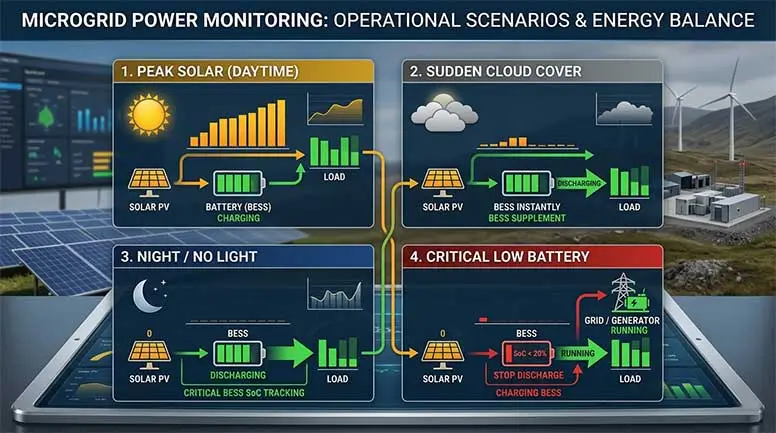
The monitoring system executes different control logics under different scenarios through complex Energy Management System (EMS) algorithms.
| Scenario Mode | Solar PV Status | Battery Storage (BESS) | Grid / Generator | Core Monitoring Action |
|---|---|---|---|---|
| 1. Peak Solar (Daytime) | Surplus Production | Charging (Absorbing excess) | Standby / Off | Prioritize solar for load; direct all excess power to BESS; monitor charging rate closely. |
| 2. Sudden Cloud Cover | Sudden Drop | Instant Discharge | Standby | System must respond in milliseconds, deploying BESS to fill the gap and prevent frequency flicker. |
| 3. Night / No Light | No Output | Main Discharge (Supporting load) | Standby (If SoC is safe) | Continuously track battery SoC (State of Charge) to ensure system stability. |
| 4. Critical Low Battery | No Output | Stop Discharge (Hit redline) | Active Running (Full load) | When SoC drops below safety threshold (e.g., 20%), instantly trigger backup grid/gen and start charging BESS. |
To achieve the above perfect balance, modern microgrid monitoring systems typically integrate the following cutting-edge technologies:
Edge Computing and IoT Gateway: Performs data acquisition and rapid control logic execution locally (Edge), eliminating reliance on cloud network latency.
AI Predictive Algorithms: Combines weather forecasts (irradiance prediction) and historical electricity load data to pre-plan the charging and discharging curves of the "photovoltaic-storage" system.
Visual Dashboard: Provides maintenance personnel with an intuitive, integrated interface to quickly grasp the flow diagram (Sankey Diagram), battery health, and historical energy efficiency ROI.
The success of off-grid microgrids depends 30% on hardware (high-quality photovoltaic modules and high-cycle batteries) and 70% on software (precise power monitoring and dispatch). By finely balancing photovoltaics, energy storage, and backup power, the monitoring system not only maximizes the value of every kilowatt-hour of green energy but also builds an unbreakable power firewall for off-grid sites.
Have you any problem, please contact us via message