
In the field of utility management (such as water, electricity, and gas), efficient data collection is the cornerstone of accurate billing, resource conservation, and operational excellence. Over the years, the utility industry has transitioned from traditional manual meter reading to more advanced technologies. Two core concepts in this technological shift are AMR (Automated Meter Reading) and AMI (Advanced Metering Architecture).
While these two terms sound similar and both aim to eliminate the need for manual meter reading, they differ fundamentally in functionality, data flow, and overall capabilities. This article will provide an in-depth analysis of the core differences between AMR and AMI, helping you understand their different implications for utility companies and consumers.
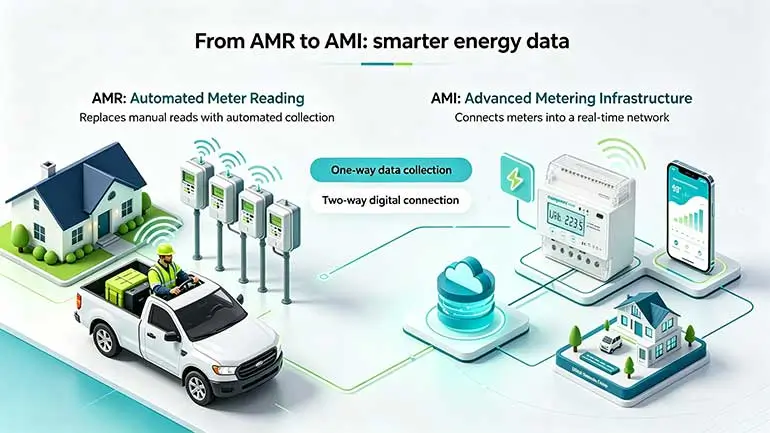
AMR (Automated Meter Reading) is a one-way communication technology. It allows utility companies to remotely collect consumption, diagnostic, and status data from meters (water, electricity, gas) via radio frequency (RF), touch technology, or cellular networks.
In an AMR system, utility companies don't need to send people to each user's meter to read the numbers. Instead, the data is automatically transmitted to a nearby receiver. Common collection methods include:
Drive-by/Walk-by: Meter readers simply drive a vehicle equipped with a receiver or use a handheld device through the community, and the meters automatically transmit the data to the receiver.
Key Feature: AMR primarily solves the problem of automating data collection, but its data flow is unidirectional—it can only be transmitted from the meter to the utility company.
AMI (Advanced Metering Infrastructure) represents a more revolutionary leap. It is a two-way communication network consisting of smart meters, a communication network, and a data management system. It not only transmits data from the user to the utility company but also transmits instructions and information back from the company to the meter.
AMI creates a continuously connected network. Smart meters not only record intermittent usage data (e.g., electricity consumption every 15 minutes) in real-time or near real-time, but also transmit this data directly to the utility company's central system via a fixed network architecture (such as mesh networks, cellular networks, or power line carriers) without any human intervention.
Key Feature: AMI is more than just "meter reading"; it's a complete smart network connecting utility companies and end users in real time.
To more intuitively understand the differences between the two, we can compare them from the following dimensions:
| Features | AMR (Automated Meter Reading) | AMI (Advanced Metering Infrastructure) |
|---|---|---|
| Communication Direction | One-way (from meter to utility company) | Two-way (intercommunication between meter and utility company) |
| Data Collection Frequency | Monthly, weekly, or daily (depending on reading frequency) | Real-time or near real-time (every 15 minutes, hourly, etc.) |
| Reading Method | Requires personnel driving/walking nearby to collect data | Fully automated, remote transmission through a fixed network |
| Network Architecture | Mobile receivers or intermittent connections | Fixed network (mesh network, cellular network, etc.) |
| Outage / Fault Detection | Cannot report actively; relies on customer phone calls for repair requests | Meters can automatically send real-time alerts to the utility company |
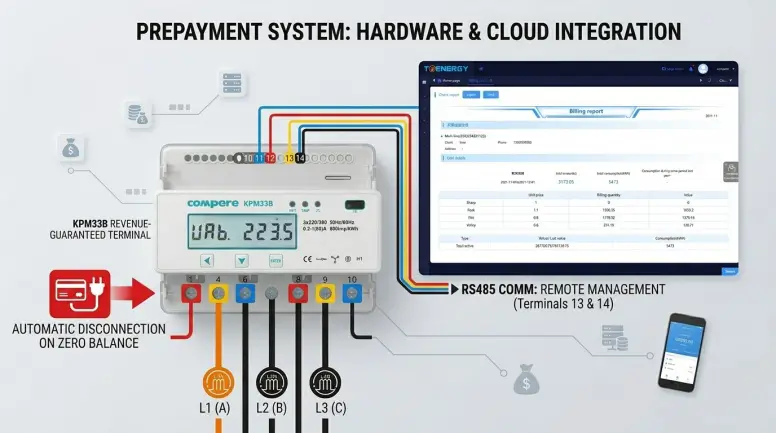
| Remote Control Capability | Minimal or none | Supports remote disconnection, reconnection, or flow limitation |
| Pricing Model Support | Only supports flat rates or simple time-of-use pricing | Supports complex dynamic pricing / Time-of-Use (TOU) |
1. Operational Efficiency and Fault Response
AMR: In the event of a power outage or leak, the AMR system typically cannot proactively notify the utility company. The company still needs to wait for the customer to call to report the problem, or wait until the next meter reading to discover the anomaly.
AMI: Smart meters have a "Last Gasp" function. When a power outage or pipe burst occurs, the meter can immediately send an alarm to the control center. This allows utility companies to address problems before customers even realize it.
2. Consumer Empowerment
AMR: Consumers only find out how much water or electricity they've used when they receive their bill at the end of the month.
AMI: With a mobile app or user portal, consumers can view hourly energy consumption charts. This transparency helps guide users to conserve energy during peak hours, thus reducing electricity or water bills.
3. Demand-Side Management (Demand Response)
AMI allows utility companies to implement dynamic pricing. During peak hours, companies can raise electricity prices and send signals to users (or connected smart home devices) via smart meters, prompting them to reduce unnecessary electricity consumption; during off-peak hours, they offer discounted rates. This two-way interaction is something AMR cannot achieve.
The choice between AMR and AMI depends on the utility company's size, budget, and long-term vision:
AMR is suitable for: Small communities or specific utilities with limited budgets, whose primary goals are eliminating the security risks of manual meter reading, improving billing accuracy, and who do not require real-time data and advanced network controls.
AMI is suitable for: Modern utilities aiming to build smart cities and modernize their power grids/water networks. While AMI requires a higher upfront investment, its long-term returns in reducing operating costs, improving customer satisfaction, detecting asset malfunctions, and promoting energy conservation and emissions reduction are substantial.
In short, AMR is a bridge that takes us out of the era of manual meter reading; while AMI is the future, transforming traditional metering tools into smart terminals for the Internet of Things (IoT) era.
Have you any problem, please contact us via message