
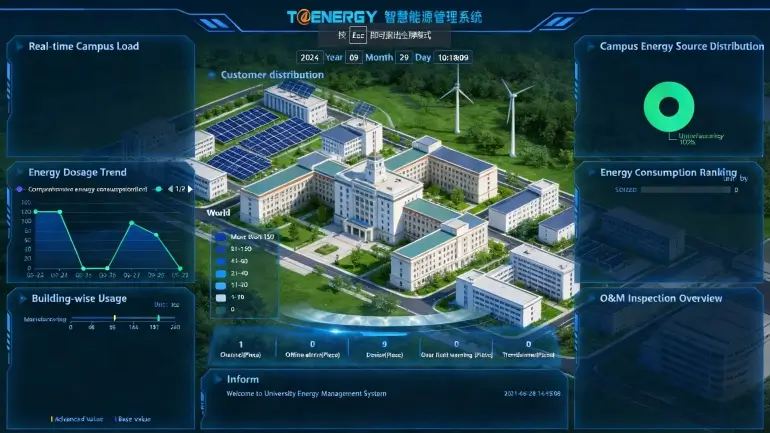
Establishing an energy management system is crucial for universities to refine energy conservation and consumption reduction efforts, improve energy efficiency, and raise awareness of energy conservation. Universities, as a significant part of public buildings, are both densely populated areas and major energy consumers. The energy environment in universities is complex, with diverse energy types, and conventional energy management methods have many shortcomings, failing to effectively manage energy consumption.
Therefore, to achieve energy conservation and emission reduction goals, universities must rely on various energy-saving equipment and technologies. However, universities themselves do not engage in the production of these technologies and equipment; this work must be done by companies engaged in the research and development of energy-saving products. Therefore, building a resource-saving university is inseparable from enterprises; the two are interdependent. The following is a comprehensive solution for university energy management systems for your reference.
1. Universities integrate teaching, research, and living areas, occupying large areas, with diverse building types, complex functional divisions, and diverse energy consumption types, resulting in high manual management costs for energy consumption.
2. Serious energy waste. 1. Schools have a large energy consumption volume, and various equipment suffers from serious energy waste, such as unattended lights, standby power consumption, running air conditioners with windows open, leaks in water pipes, unreasonable equipment configuration, and inadequate maintenance of aging equipment.
3. Low energy utilization rate. Most universities have not established energy efficiency assessment indicators, and energy-consuming groups have a weak awareness of energy conservation.
4. Inappropriate configuration of energy-consuming equipment and untimely processing of energy consumption data. Large public buildings (such as libraries, teaching buildings, and gymnasiums) may have problems such as unreasonable equipment configuration, huge energy consumption, and unreasonable use and management.
5. Traditional energy management methods. The degree of automation in campus operation and maintenance is low, and operation and maintenance management work mainly relies on manual inspections; the energy management situation and equipment energy consumption of the entire campus are understood through manual data recording, which is insufficient to identify potential risks and energy-saving opportunities.
The energy management system for universities should be designed to measure and control all electricity, chilled water, heat, streetlights/lighting/air conditioning consumption within the campus building complex. Based on comprehensive monitoring of energy consumption data, this system aims to understand the current energy usage status of the campus, continuously improve the campus energy consumption operation and management level, comprehensively enhance the campus energy planning and construction level, establish and manage an energy consumption evaluation system and assessment indicators, and comprehensively improve the construction of an energy-saving campus.
(1) Ensuring a safe and reliable power supply to the campus's power distribution system;
(2) Understanding the safety hazards of energy-consuming equipment, accurately identifying equipment failure points, and reducing the failure rate of energy-consuming equipment;
(3) Classifying and statistically analyzing the electricity consumption of various departments and faculties on campus, providing data basis for energy efficiency assessment;
(4) Continuously monitoring the operation of the power distribution room 24 hours a day, improving the overall level of equipment management, and reducing the pressure on maintenance personnel;
The university energy management system emerged in this context. The energy management system provides universities with an effective means of information-based energy consumption management, helping to improve the management level of operating equipment, reduce the labor costs of maintenance personnel, and enhance energy conservation awareness.
Have you any problem, please contact us via message